In a nutshell
- It carries real risk and it is managed rather than eliminated. You get a briefing, a guide who rides with you, a prepared track and the ability to set your own speed.
- Almost every incident on a sled run comes from going faster than you can steer. Heels down works, and nobody is timing you.
- Nothing straps you to the sled. If it goes wrong you part company with it, which is why the briefing spends its time on how to fall.
- A minimum age of ten, a weight limit of 125 kilograms, and exclusions for pregnancy and for back or heart conditions. All of them describe a real load.
What the actual risks are
The honest list is short and unglamorous. You can come off the sled on a corner, which usually means sliding a few metres on packed snow. You can collide with another sledder, which is why gaps and stopping distances get so much attention in the briefing. And you can hurt a wrist or an ankle putting a hand or a foot out awkwardly, which is the most common way anybody gets injured on a sled run anywhere.
None of these are exotic. They are the risks of a moderately fast, low, self-steered vehicle on a hard surface, and they scale directly with speed. A sledder travelling at a pace they can actually control is doing something with a comparable risk profile to any other winter activity; one travelling faster than that has removed their own margin.
The dark adds a factor rather than a category. It lengthens reaction time and makes a stopped sled harder to see, which is handled by leaving bigger gaps and by the guide stopping the group regularly.
What the briefing covers, and why it is first
There is a safety briefing before anybody gets on a sled, and it happens at the top rather than at the meeting point in town, which is the right place: you are looking at the actual track in the actual conditions when you are told how to ride it.
The content is practical. How to sit, how to steer with a lean and a heel, how to brake properly with both heels rather than tentatively with one, how much room to leave, what to do if you come off, and where the guide will be. It is short because it needs to be remembered rather than admired.
The part people underestimate is braking. The instinctive dab does very little, and the difference between that and a committed heels-down stop is the difference between arriving at a corner in control and arriving at it as a passenger.
How the group is managed on the way down
A guide rides the run with the group rather than waving it off from the top, and that single fact does more for safety than any equipment. The pace is set from the front by somebody who knows the track, which prevents the natural drift towards everybody going as fast as the boldest person present.
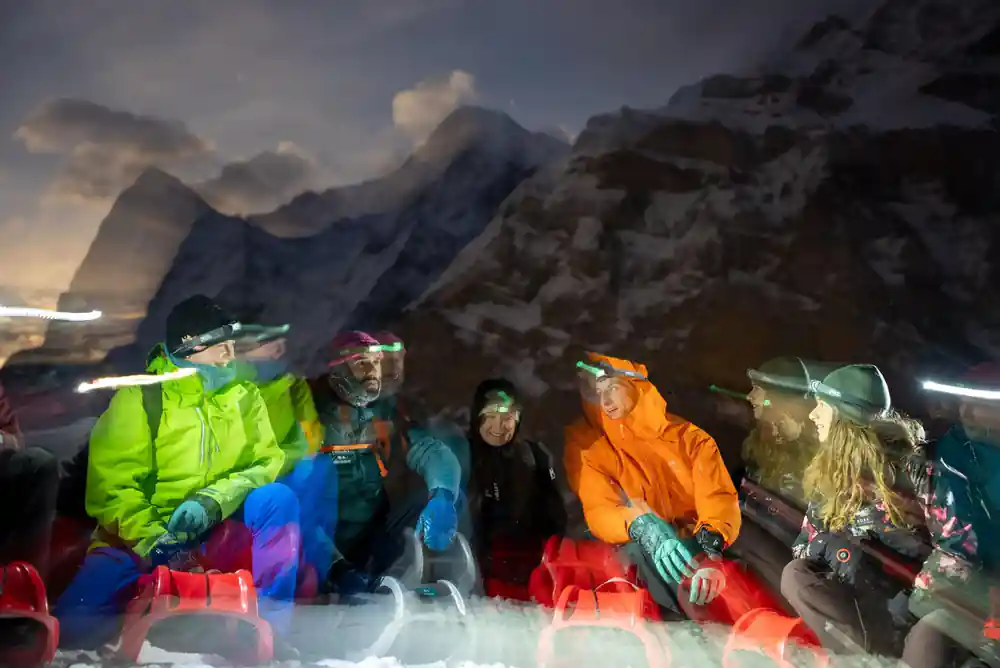
Frequent stops are built into the descent to let the line close up. Sledders separate quickly, because confidence varies enormously and speed follows confidence, and a group strung out over a long run in the dark is the situation nobody wants. Regrouping resets it every few minutes.
It also means that if somebody does come off, they are found immediately rather than at the bottom. On an unlit mountain that is the difference that matters.
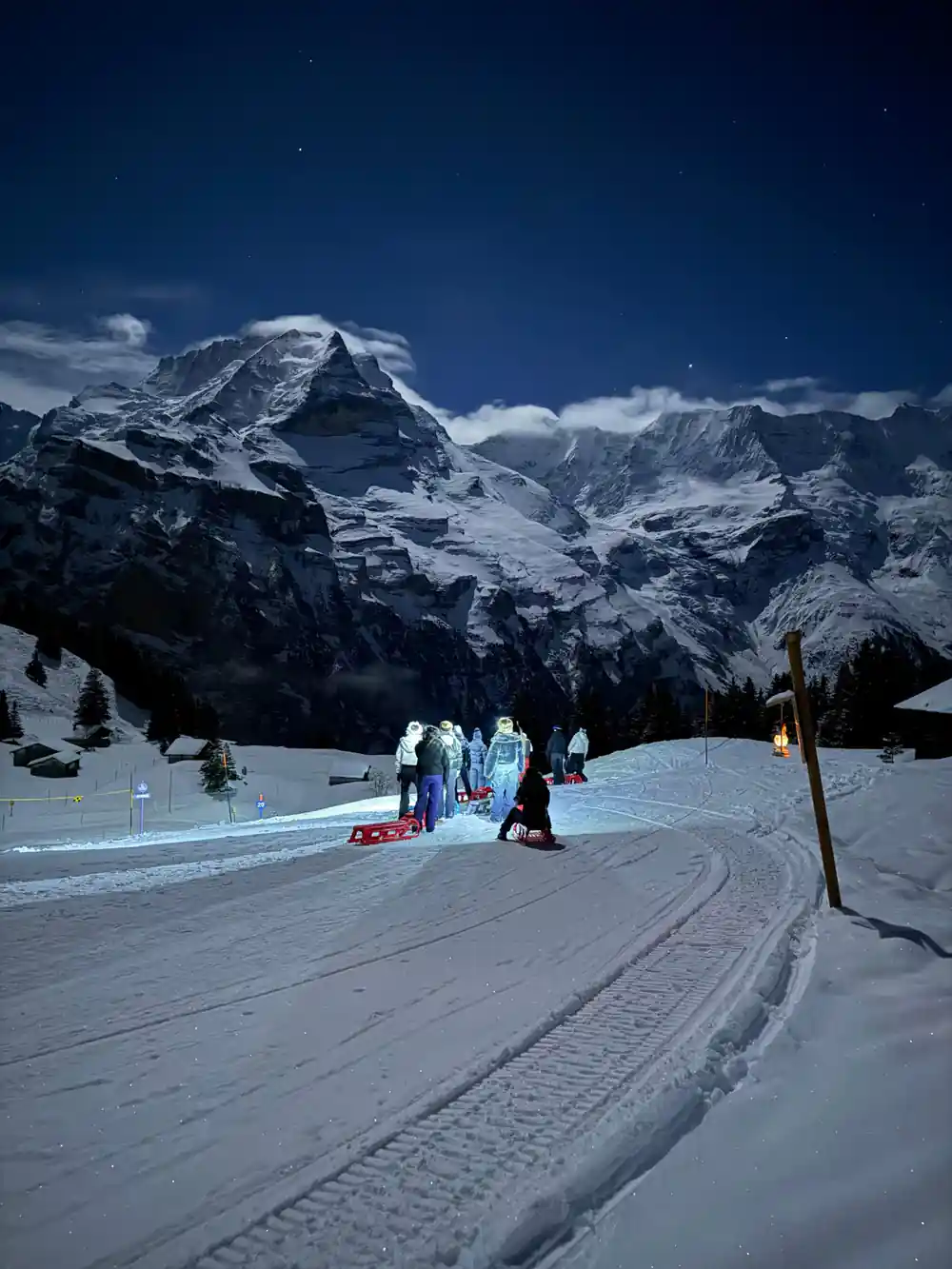
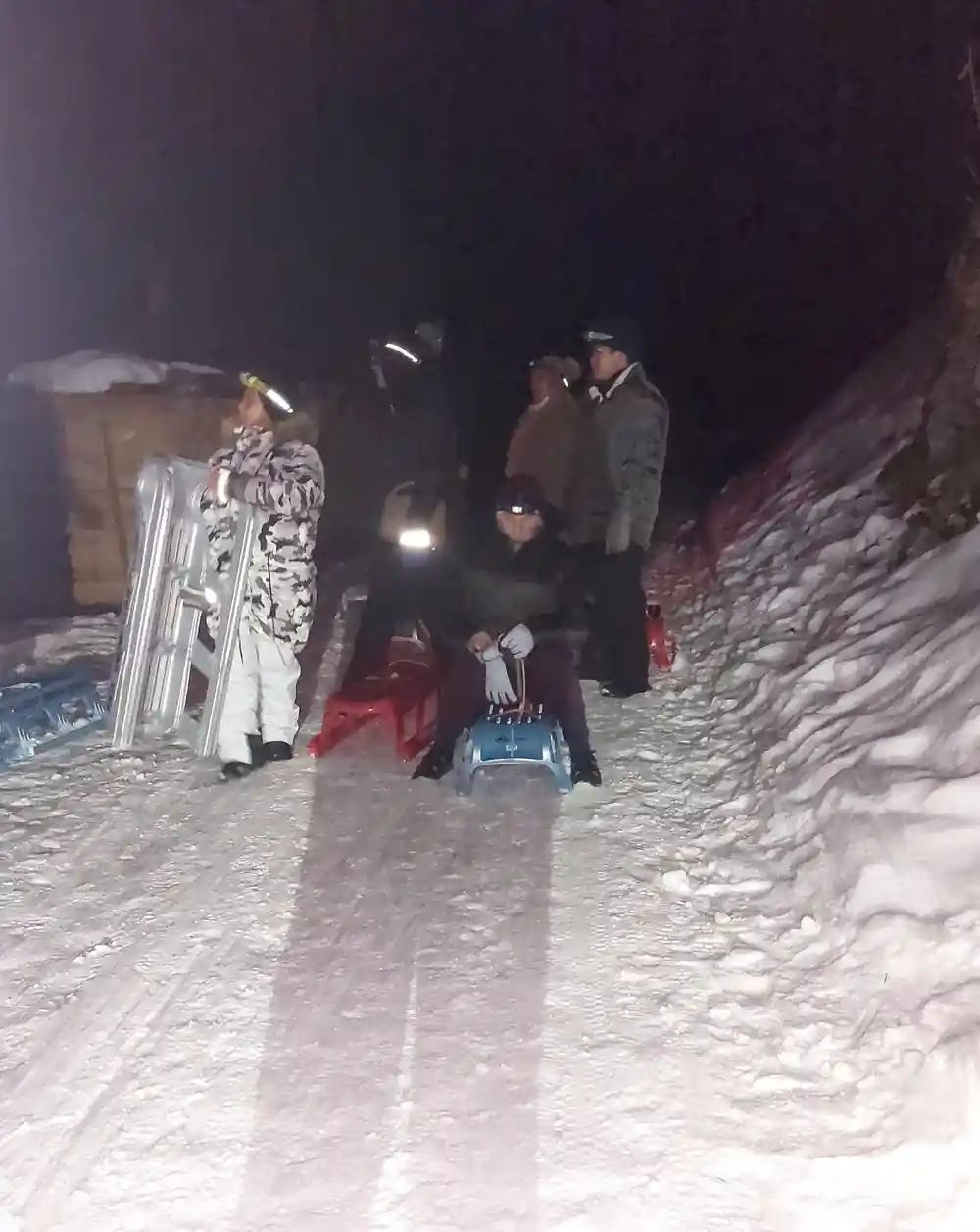
The line pulled up at a stop, waiting for the back of the group to close up
Why coming off is not the disaster it sounds
There is nothing holding you to the sled: no belt, no cage, no fixing of any kind. That sounds like an omission and it is the opposite. In almost every situation where a sled is going somewhere you do not want it to, the best available outcome is that you and it separate, and the design allows that to happen instantly and without thought.
What follows is usually undramatic. You slide, on snow, wearing clothing designed for exactly that, at a speed that is already falling because friction is doing its work. The briefing tells you to keep your limbs in rather than reaching out, because a planted hand at speed is how wrists get hurt.
The sled, meanwhile, stops on its own fairly quickly. Retrieving it and getting going again is the normal and slightly comic ending to most incidents on a run of this kind.
The restrictions, and the reason for each
The minimum age is ten. Below that, the combination of reach, strength and judgement needed to brake reliably is not there, and braking is the one thing that cannot be delegated to the guide. Under-eighteens also cannot come unaccompanied, which is a supervision rule rather than a physical one.
There is a weight limit of 125 kilograms, which is about the sled rather than the rider: a runner sledge is a rated piece of equipment and loading it beyond its design changes how it tracks and how it stops.
Pregnancy, back problems and heart problems are all excluded, and all three describe the same underlying reality. A sled run is bumpy, the impacts are transmitted straight up the spine, and the combination of cold air, adrenaline and physical effort is a genuine cardiovascular load. These are not liability boilerplate.
What you can do to make it safer
Wear the right clothing, which is the recommendation that turns up in almost every review and which the rental shop at the meeting point exists to solve. Cold hands cannot grip and cold reflexes are slow, and both of those are safety items rather than comfort items.
Leave a bigger gap than feels necessary, look further ahead than feels natural, and brake before the corner rather than in it. That is essentially the whole of the technique and it is why the activity works for complete beginners.
And be honest with yourself about speed. There is no race, the guide is not timing anybody, and the run is long enough that a comfortable pace still delivers everything you came for. The people who enjoy it most are rarely the fastest ones.
A briefing, a guide, a prepared track and your own pace
from US$123Reserve now & pay later
Your questions, answered
Is night sledding dangerous?
What are the most common injuries?
Is it more dangerous in the dark?
How do you stop a sled?
What happens if I fall off?
Is there a guide with you the whole way?
Why is the minimum age ten?
Why are back and heart problems excluded?
How safety is handled
A briefing before anyone rides
Held at the top, looking at the actual track in the actual conditions: how to sit, steer, brake, leave room, and what to do if you come off.
Boots and a proper sled
Hiking boots are provided if you need them, because your heels are the brakes, and the sled is a rated runner sledge rather than improvised equipment.
A guide rides in front
The pace is set from the front by somebody who knows the run, which stops the group drifting towards the speed of its boldest member.
Regular stops to regroup
Sledders separate quickly because speed follows confidence. Pulling the line together every few minutes means nobody is alone on the mountain.
Nothing straps you in
If the sled is going somewhere you are not, you part company with it. Keep your limbs in rather than putting a hand out, and let the snow do the slowing.
Restrictions applied before booking
Minimum age ten, weight limit 125 kilograms, and exclusions for pregnancy and back or heart conditions. Read them before you book, not at the gondola.